
APPLICATIONS / DYES & PIGMENTS PROCESSING
Glass-Lined Equipment for Dyes & Pigments Processing
Dyes and pigments batch processes may combine corrosive media with solids charging, suspension, dispersion and repeated mixing duties.
Equipment selection should consider how solids enter the vessel, how uniformity is maintained during the batch, and how the finished material is discharged or transferred to downstream equipment.
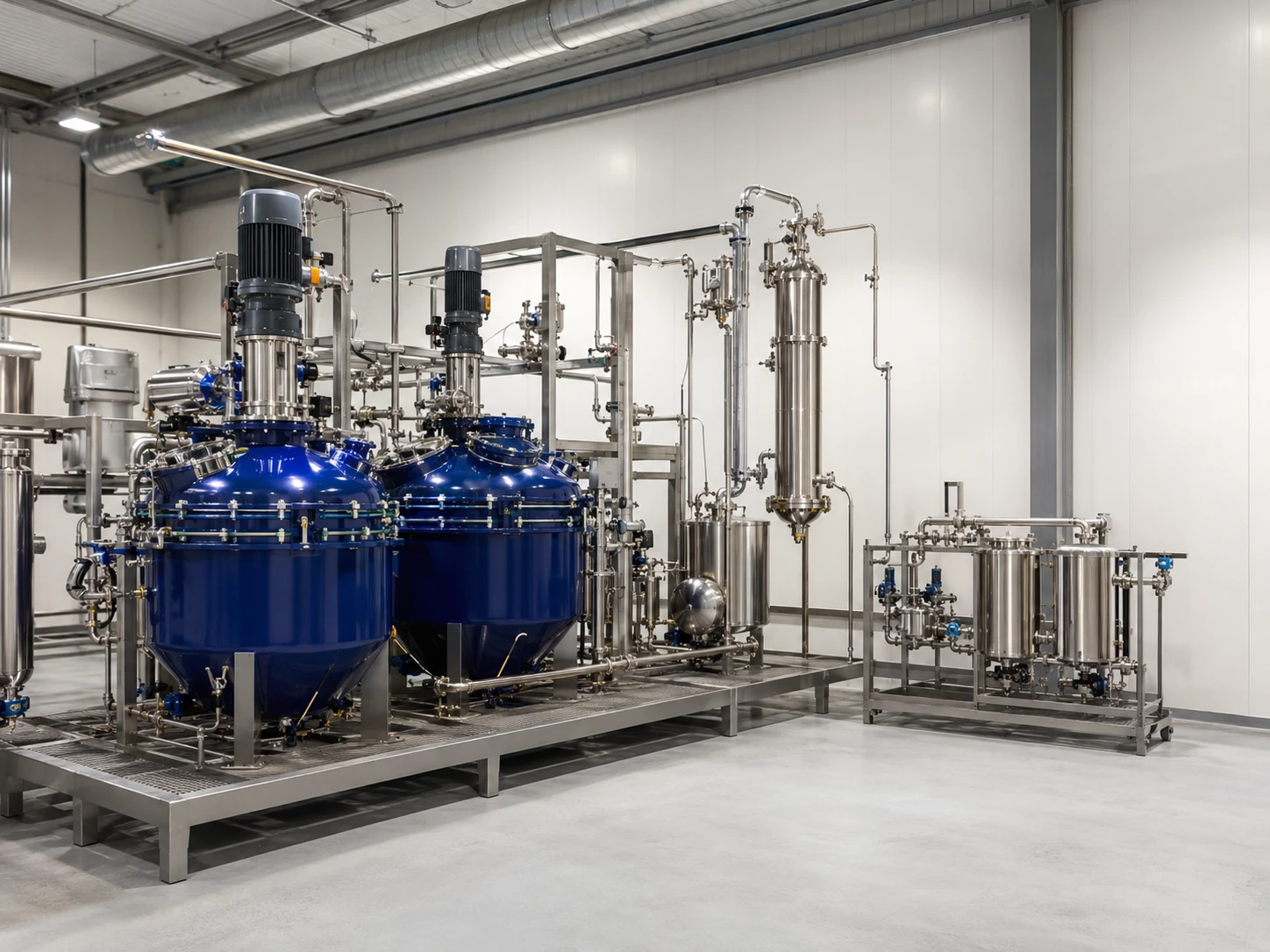
Selecting glass lined equipment for dyes and pigments starts with the solids profile, process medium and batch sequence. The equipment discussion should connect charging, incorporation, suspension, mixing uniformity, cleaning context and discharge or transfer rather than relying on a generic vessel arrangement.
01 / PROCESS CONTEXT
Solids Handling Changes the Mixing and Equipment Requirement
Dyes and pigments processes may involve dry or pre-wetted solids entering a liquid phase, remaining suspended during reaction or processing, and then moving through discharge or transfer steps. The equipment should be defined around the solids behaviour and the required mixing objective.
Solids Charging
Clarify how and when solids enter the vessel and whether they are added in one step or progressively during the batch.
Suspension
Define whether solids need to remain suspended, become dissolved, or stay uniformly distributed through a specific process stage.
Mixing Uniformity
Describe what uniformity means for the process and at which points in the batch it matters most.
Corrosive Process Media
The process medium and operating conditions should be reviewed separately from the solids-handling duty when evaluating the product-contact surface.
02 / SOLIDS PROFILE
The Solids Profile Should Be Defined Before the Agitation Requirement
A general statement such as “contains solids” is not enough to define the mixing duty. The equipment discussion should identify how the solids behave during charging, incorporation, suspension, reaction and discharge.
Where information is available, describe the solids form, tendency to settle, charging sequence and whether the process expects dissolution, suspension or dispersion.
Charging Method
How solids are introduced into the vessel.
Incorporation
Whether the material should wet, dissolve or disperse into the liquid phase.
Settling Behaviour
Whether solids tend to settle when mixing intensity changes or stops.
Discharge Behaviour
How the finished batch is expected to leave the reactor or vessel.
03 / SUSPENSION & MIXING UNIFORMITY
Mixing Should Follow the Required Solids Behaviour
The agitation objective should be defined from the process duty rather than from a generic impeller description. A dyes or pigments batch may require incorporation, suspension, circulation, dissolution or uniform distribution at different stages.
The vessel, agitator and working volume should therefore be reviewed together around the behaviour that matters to the batch.
Incorporation
Bring introduced material into the active liquid phase.
Suspension
Maintain solids distribution where required by the process.
Circulation
Support movement through the vessel and interaction with heating or cooling surfaces.
Uniformity
Maintain the process condition required before reaction, sampling, discharge or transfer.
See Glass-Lined Agitators for the related equipment role.
04 / PROCESS SEQUENCE
Follow the Solids Through the Batch
This sequence illustrates the process relationship rather than a fixed dyes or pigments production line. Individual batches may use a different order of operations.
05 / EQUIPMENT ROLES
Equipment Roles Around a Solids-Handling Batch
Glass lined equipment for dyes and pigments should be considered as a connected arrangement of reaction, agitation, receiving and transfer duties.
Reaction
Glass-lined reactors can support suitable corrosive batch duties where reaction, mixing and thermal control are required. See Glass-Lined Reactors.
Agitation
The agitation arrangement should follow the actual incorporation, suspension, circulation or uniformity objective. See Glass-Lined Agitators.
Feed / Receiving
Glass-lined vessels may support liquid preparation, intermediate receiving or temporary holding around the main process step. See Glass-Lined Storage Vessels.
Transfer
Glass-lined piping and fittings can connect process equipment where corrosion-resistant product-contact transfer is required. See Glass-Lined Piping & Fittings.
The required equipment depends on the actual batch route. Not every dyes or pigments process uses all of these equipment types.
06 / CLEANING & CHANGEOVER
Cleaning Requirements Should Follow the Product and Batch Sequence
Dyes and pigments production may involve material remaining at vessel surfaces, process connections or transfer interfaces after discharge. Cleaning and product changeover requirements should therefore be considered together with access and equipment layout.
The review should focus on the actual operating sequence and the areas exposed to the process rather than making a generic cleaning-performance claim.
Process-Contact Areas
Identify surfaces and interfaces exposed to the batch.
Access
Consider inspection, maintenance and practical cleaning access.
Connections
Review feed, discharge and transfer points around the process route.
Changeover
Clarify whether the equipment will serve repeated batches of the same product or changing products.
07 / ENGINEERING CONSIDERATIONS
Conditions That Change the Equipment Basis
PROCESS MEDIUM
Chemistry and product-contact requirements.
SOLIDS PROFILE
Solids form, charging sequence and behaviour where known.
MIXING OBJECTIVE
Incorporation, dissolution, suspension, circulation or uniformity.
OPERATING CONDITIONS
Temperature and pressure / vacuum where applicable.
THERMAL DUTY
Heating or cooling requirements during the relevant batch stages.
DISCHARGE & TRANSFER
How the finished material leaves the vessel and connects to downstream equipment.
08 / PROJECT INPUTS
What to Share for a Dyes or Pigments Process Review
Defining glass lined equipment for dyes and pigments
Use these inputs to connect the solids profile and mixing objective to the process route.
- Process medium
- Solids description
- Batch / working capacity
- Solids charging sequence
- Mixing objective
- Operating temperature
- Pressure / vacuum where applicable
- Heating / cooling requirement
- Discharge / transfer requirement
- Existing specification / drawing / photo
If solids data or process details are incomplete, send the known batch sequence and available equipment information first. The initial technical discussion can begin from the information already available.
09 / RELATED EQUIPMENT
Related Equipment
FAQ
FAQ
Why do solids affect equipment selection in dyes and pigments processing?
Solids can change the required charging, incorporation, suspension, mixing and discharge duties. The choice of glass lined equipment for dyes and pigments should therefore be considered together with the vessel and agitation arrangement.
What information is useful when reviewing the agitation requirement?
Useful inputs include the solids description, charging sequence, working capacity, mixing objective, operating conditions and how the material behaves during the batch.
Does every pigments process require the same agitator configuration?
No. The appropriate agitation arrangement depends on whether the process requires incorporation, dissolution, suspension, circulation, dispersion or another defined mixing objective.
Why does discharge and transfer matter in a solids-handling process?
The final product behaviour can affect how the material leaves the vessel and how receiving or transfer equipment should connect to the process.
Can GLP review an existing dyes or pigments reactor specification?
Yes. Existing datasheets, drawings, photos and available process information can be used as the starting point for technical clarification.
APPLICATION REVIEW
Start With the Solids and Mixing Duty
Share the process medium, solids description, batch sequence and required mixing objective. GLP can begin from the available process information and clarify missing equipment inputs during technical review. This provides a starting point for discussing glass lined equipment for dyes and pigments around the actual batch route.
DISCUSS YOUR DYES OR PIGMENTS PROCESS
sales@glasslinedprocess.com
WhatsApp: +86 158 5335 1678
WeChat: 15853351678