
APPLICATIONS / SPECIALTY CHEMICAL PROCESSING
Glass-Lined Equipment for Specialty Chemical Processing
Specialty chemical production can involve widely different media, batch duties and operating sequences across individual products or campaigns.
Equipment selection should therefore define the intended duty range, process interfaces and equipment roles before assuming that one reactor or vessel configuration can cover every product.
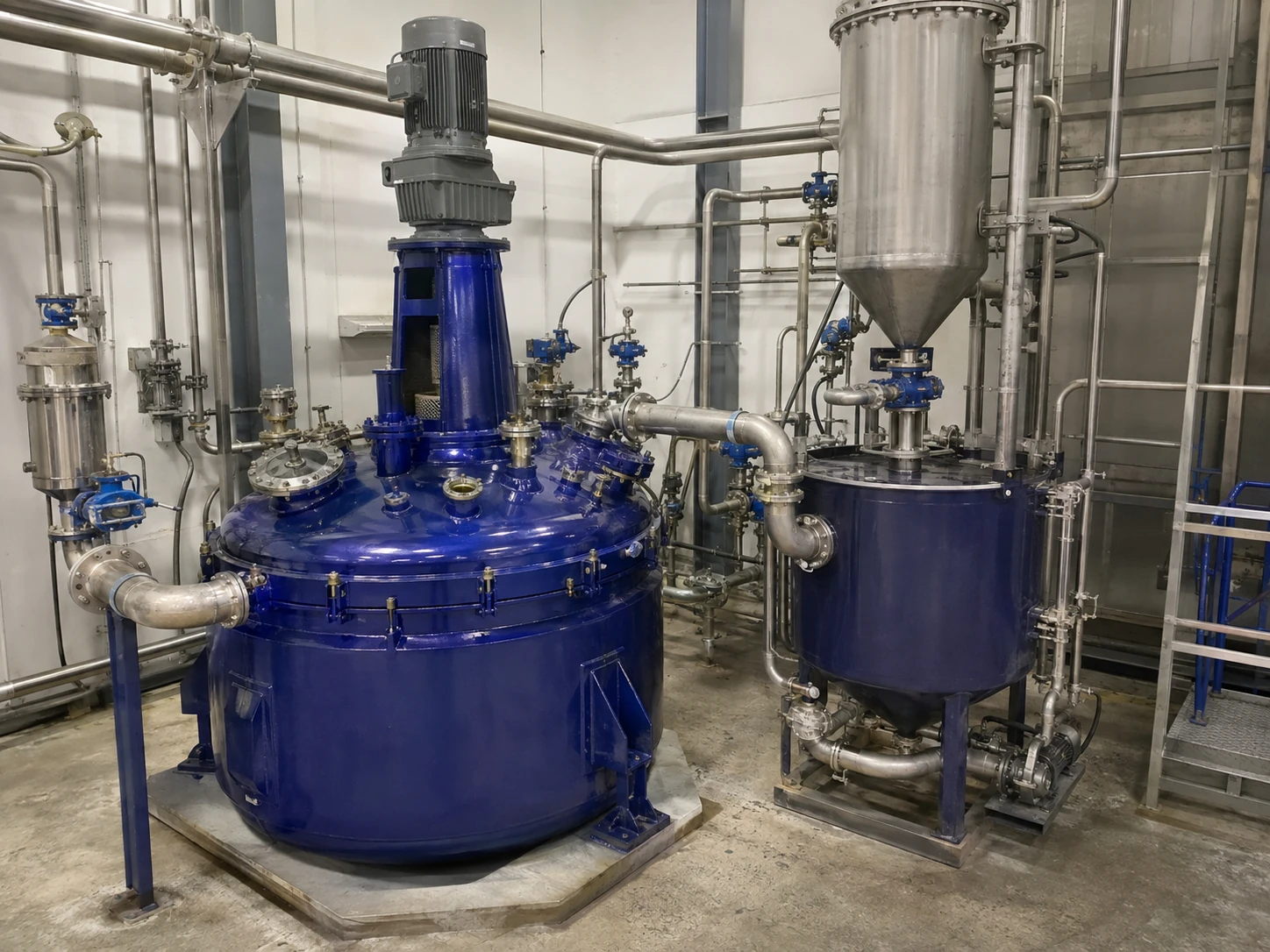
Selecting glass lined equipment for specialty chemicals starts with the intended product range, duty envelope and process interfaces. The equipment discussion should identify which functions can be shared and which need to remain product-specific.
01 / PROCESS CONTEXT
Specialty Chemical Equipment Must Be Defined Around the Intended Duty Range
Specialty chemical production may combine different chemistries, batch sizes, mixing objectives, thermal duties and transfer arrangements across the equipment’s intended operating life. The key question is not simply “what product is being made?” but “what duties must the equipment support?”
Variable Chemistry
Different products or campaigns may expose the process equipment to different media and product-contact conditions.
Different Batch Duties
Reaction, blending, dissolution, suspension, holding or transfer requirements may vary significantly between products.
Flexible Operating Conditions
Temperature, pressure or vacuum, working volume and mixing demand may not remain identical across the intended product range.
Custom Interfaces
Feed, discharge, utility, instrumentation and connected-equipment requirements may need to support more than one process arrangement.
02 / DUTY ENVELOPE
Define the Duty Envelope Before Defining the Equipment
Where equipment is intended to support more than one specialty chemical duty, the useful starting point is the range of functions and operating conditions it must accommodate.
The review should separate the common requirements shared across products from the duties that are unique to individual campaigns. This helps avoid defining the vessel around one product while overlooking the wider operating range.
Common Duties
Functions that apply across most or all intended products.
Variable Duties
Mixing, heating, cooling or reaction requirements that change between campaigns.
Operating Range
The expected variation in working volume and mechanical operating conditions where known.
Interface Range
Connections and downstream relationships that may differ between process routes.
03 / VARIABLE CHEMISTRY
Different Products Can Change the Product-Contact Requirement
Specialty chemical campaigns may involve different media, concentrations or cleaning contexts. The product-contact requirement should therefore be reviewed against the intended chemistry rather than inferred from the industry label alone.
Where the chemistry varies, compatibility should be confirmed from project-specific information instead of assuming that one material decision automatically covers the full product range.
Media Range
Identify the relevant process media for the intended campaigns.
Process Stage
Clarify when the medium contacts the reactor, vessel or connected equipment.
Cleaning Context
Include cleaning media or changeover conditions where they affect product-contact requirements.
Project-Specific Review
Use actual chemistry and operating conditions for compatibility confirmation.
04 / CAMPAIGN FLEXIBILITY
Campaign Flexibility Depends on the Functions the Equipment Must Share
Multipurpose equipment is useful only when the shared configuration remains practical across the intended process duties.
A reactor that works well for one product may require a different feed arrangement, agitation emphasis or connected equipment for another. The shared equipment basis should therefore be built around the overlapping duties while clearly identifying product-specific requirements.
Reaction
Which campaigns require reaction duty and under what general operating conditions.
Mixing
Which mixing objectives are common and which differ between products.
Thermal Duty
Where heating or cooling requirements change between campaigns.
Receiving / Transfer
How upstream and downstream equipment relationships vary between process routes.
05 / CUSTOM PROCESS INTERFACES
Interfaces Often Determine Whether a Multipurpose Configuration Is Practical
Specialty chemical projects may involve different raw-material feeds, receiving vessels, utility connections, instrumentation points and transfer routes.
These interfaces should be considered as part of the equipment definition because a vessel can be mechanically suitable while still being difficult to integrate into the intended process arrangement.
Feed Connections
Identify the feed paths that need to connect to the vessel.
Discharge / Transfer
Clarify where the batch goes after the vessel and how it is transferred.
Utilities
Review heating, cooling and other plant connections relevant to the duty.
Connected Equipment
Consider receiving vessels, condensers, columns, piping or other process equipment where applicable.
See Process Interfaces & Nozzle Review for the related engineering path.
06 / EQUIPMENT ROLES
Build the Equipment Package Around the Required Functions
Reaction
Glass-lined reactors can support suitable specialty chemical reaction duties where the process chemistry and operating conditions fit glass-lined construction. See Glass-Lined Reactors.
Mixing
Agitation should follow the required blending, dissolution, suspension, circulation or reaction duty. See Glass-Lined Agitators.
Feed / Receiving / Holding
Glass-lined vessels can support preparation, receiving, buffering or intermediate holding where required by the process route. See Glass-Lined Storage Vessels.
Condensation / Separation
Where the process includes vapor handling, recovery or separation, suitable columns or condensation equipment may form part of the system. See Distillation & Condensation Equipment.
Transfer
Glass-lined piping and fittings can connect equipment where corrosion-resistant product-contact transfer is required. See Glass-Lined Piping & Fittings.
Not every specialty chemical process requires all of these equipment types. The equipment package should follow the actual duty map.
07 / EQUIPMENT BOUNDARY
Not Every Duty Should Be Forced Into One “Universal” Configuration
A multipurpose process does not automatically mean that every product should use the same vessel, agitation arrangement or interface layout.
Where duties differ substantially, the technical review should determine which functions can reasonably share equipment and which require a different configuration or supporting process equipment.
08 / ENGINEERING CONSIDERATIONS
Information That Defines a Specialty Chemical Equipment Basis
INTENDED PRODUCT RANGE
Describe the product families or campaigns the equipment is expected to support.
PROCESS DUTIES
Reaction, mixing, holding, heating, cooling, receiving or transfer requirements.
OPERATING CONDITIONS
Working volume, temperature and pressure / vacuum where applicable.
MIXING OBJECTIVES
Blending, dissolution, suspension, circulation or reaction duty.
PRODUCT-CONTACT REQUIREMENTS
Relevant process media and cleaning context.
PROCESS INTERFACES
Feed, discharge, utility, instrumentation and connected-equipment requirements.
09 / PROJECT INPUTS
What to Share for a Specialty Chemical Process Review
- Intended product / campaign range
- Main process duties
- Process medium
- Batch / working capacity
- Operating temperature
- Pressure / vacuum where applicable
- Mixing requirements
- Heating / cooling duty
- Feed / discharge / receiving interfaces
- Existing specification / drawing / photo / nameplate where available
If the full operating range is not yet finalized, share the main products, common duties and known differences first. The initial equipment discussion can begin from the available process information.
10 / RELATED EQUIPMENT
Related Equipment
FAQ
FAQ
Why does specialty chemical processing require a wider equipment review?
Specialty chemical production can involve different media, batch duties, operating conditions and interfaces across individual products or campaigns. The equipment should therefore be reviewed around the intended duty range rather than one industry label.
Can one reactor be used for multiple specialty chemical products?
It can be discussed where the intended chemistries, operating conditions, mixing duties and process interfaces remain suitable for the planned product range. Substantially different duties may require different equipment or supporting arrangements.
What information is useful when defining a multipurpose equipment requirement?
Useful inputs include the intended product range, process duties, working capacity, operating conditions, mixing objectives, product-contact media and required process interfaces.
Why are process interfaces important in specialty chemical projects?
Different campaigns may use different feed, discharge, receiving, utility or downstream connections. These interfaces can affect whether one equipment configuration is practical across the intended process range.
Can GLP review an existing specialty chemical equipment specification?
Yes. Existing datasheets, drawings, photos, nameplate information and known process conditions can be used as the starting point for technical clarification.
APPLICATION REVIEW
Start With the Intended Duty Range
Share the products or campaigns the equipment needs to support, together with the main process duties and known interfaces. GLP can begin from the available information and clarify the equipment boundary during technical review.
DISCUSS YOUR SPECIALTY CHEMICAL PROCESS
sales@glasslinedprocess.com
WhatsApp: +86 158 5335 1678
WeChat: 15853351678